
Weekly Credit Crunch 26 October 🌟
Welcome back to another edition of Kath's Credit Crunch.
Can you believe it's less than two months until Christmas? Because I can't! 2026 is flying by... but there's still plenty of opportunities out there this Spring if you know where to look.
This week, we've got plenty of new updates for you. Plus, our Credit Coaching segment is back again with a deep dive into complex PAYG income.
Let's get straight into it. 👇
🏦 CBA
Cotality Estimated Rental Amount Property Report
CBA has introduced the Cotality Estimated Rental Amount Property Report (PDF report) as an acceptable verification option to validate a customer’s estimated rental income for untenanted properties.
This provides an alternative to obtaining a rental appraisal and/or external valuations.
What you need to do:
-
Have a discussion with your customer and input the proposed customer-declared rental amount.
-
Generate a Cotality Property Report to validate your customer’s rental estimate.
-
Note: You don't need to email the report as part of your supporting documents.
-
If the report does not reflect the property’s current condition due to recent renovations or major works, a rental appraisal with supporting comparable properties will need to be obtained.
Customer Identity Verification Changes – From Monday 23 November 2026
From Monday 23 November 2026, CBA is enhancing customer identity checks.
New-to-Bank customers:
New-to-Bank customers must complete digital onboarding before they can enter the verification code and join the application.
Existing-to-Bank customers:
After joining the application, the bank will check the customer’s previous identity verification records.
Construction Loan Changes – Australian Government 5% Deposit Scheme
If a customer who has settled under the Australian Government 5% Deposit Scheme requires either:
-
An extension to their construction loan term; or
-
An increase to their construction loan amount due to construction-related changes;
The request must now be reviewed and approved by Housing Australia before it can proceed.
What has changed?
Where a settled Australian Government 5% Deposit Scheme loan requires a construction-related amendment, the request must now be referred to Housing Australia for assessment and approval.
This includes requests relating to:
-
Increases in building contract costs.
-
Delays to construction completion timeframes.
-
Extensions to construction loan terms.
-
Other changes that require an amendment to the settled Guarantee.
Why is this important?
Housing Australia approval is required before any construction-related change to an existing settled Guarantee can proceed.
Following the correct referral process ensures the proposed change is assessed against Scheme requirements before any amendment is made.
What you need to do:
If your customer requires a construction loan increase, extension or other construction-related amendment, please contact your Relationship Manager and provide the relevant information to support the request.
Your Relationship Manager will raise the request with Product for review. Product will then refer the request to Housing Australia for assessment and approval.
Any proposed change to an existing settled Guarantee is subject to Housing Australia approval and must continue to meet all applicable Scheme requirements.
🏦 Firstmac
Self-Employed – Alt Doc
Firstmac Alt Doc allows eligible borrowers to verify their income using 6 months of BAS plus an ATO Account Summary, with no tax returns or financial statements required.
Self-Employed Firstmac Alt Doc is available for:
-
Owner Occupied and Investment.
-
Purchase and Refinance.
-
Debt Consolidation and Equity Release.
-
Principal & Interest or Interest Only.
-
Up to 80% LVR.
-
Loan amounts up to $3 million at 70% LVR and $2 million at 80% LVR.
-
Offset available.
-
No annual or monthly fees.
Simple income verification – to apply, your client will need:
-
Minimum 24 months ABN registration.
-
Minimum 12 months GST registration.
-
6 months of BAS, covering a minimum of two quarters – original PDF.
-
ATO Account Summary – original PDF.
-
A completed Declaration of Financial Status (available in Broker Tools).
-
Standard identification and security documentation.
🏦 Resimac
Credit Policy Updates: Self-Employed Income, Casual Earnings and Debt Consolidation
Resimac has introduced several credit policy changes this week that are worth highlighting.
These updates provide greater flexibility across self-employed and Alt Doc applications, casual and variable income assessments, income verification and ATO debt consolidation.
Here's a summary of the key changes.
Self-Employed Income and ABN Requirements
-
Reduced minimum ABN registration period: The minimum ABN registration period has been reduced from 24 months to 18 months across self-employed and Alt Doc income applications.
-
Additional pathway for newer ABNs under Prime Alt Doc: ABNs registered for less than 24 months may still be considered under Prime Alt Doc, provided the applicant demonstrates at least 18 months of continuous trading and 12 months of previous experience in the same industry. This must be verified using six months of Business Activity Statements (BAS).
-
Tax debt now acceptable as an Alt Doc loan purpose: Tax debt is no longer an excluded loan purpose under Alt Doc, providing greater flexibility for eligible applications.
Casual, Commission and Bonus Income
-
Updated casual income annualisation: Casual income can now be annualised using year-to-date (YTD) earnings, provided at least three months of YTD income is available. Where less than three months of YTD income is available, the lower of annualised YTD earnings and the previous financial year’s income will be used.
-
Flexibility for applicants new to a casual role: Applicants with less than six months in their current casual role may still be considered if they can demonstrate 12 months of continuous employment history in a similar role.
-
Bonus income assessed in line with commission income: Bonus income will now follow the same assessment approach as commission income, with 100% accepted where the applicant has at least six months in their current role or two years of industry experience.
Income Verification and Rental Income
-
Simplified PAYG income verification: PAYG income can now be verified using one payslip and the applicant’s most recent ATO Income Statement.
-
Reduced documentation for private lease rental income: Additional bank statements and tax returns are no longer required alongside the lease agreement for private lease rental income verification.
ATO Debt Consolidation
Expanded eligibility under Prime Alt Doc: ATO debt consolidation is now available under Prime Alt Doc, in addition to Prime Uninsured Full Doc and Specialist.
The existing limits remain unchanged:
-
Maximum 80% LVR.
-
Maximum $200,000 in ATO debt consolidation.
-
The ATO debt must be paid in full as part of the transaction.
🏦 Wave Money
ATO Debt Consolidation – Self-Employed Borrowers
Got a self-employed client carrying significant ATO debt?
Wave Money takes a commonsense approach to ATO Debt Consolidation.
Here's where Wave Money can help:
-
No prescribed dollar limit on ATO debt consolidation.
-
Full Doc and Alt Doc lending options.
-
Use available property equity to consolidate ATO debt.
-
Other debt consolidation can also be considered.
-
Flexible servicing.
For the right borrower, consolidating ATO debt can mean lower monthly commitments, improved cash flow and more capacity to focus on growing the business.
Education & Updates
🏦 Bankwest
Bankwest: The Bankwest Edge
Wednesday 4 November | 12:00 pm – 1:00 pm AEDT
Join Bankwest for an interactive session covering updates to their broker portal, key policy and process changes, and practical tips for working together.
The session will include an interactive quiz and a live Q&A.
🏦 Westpac
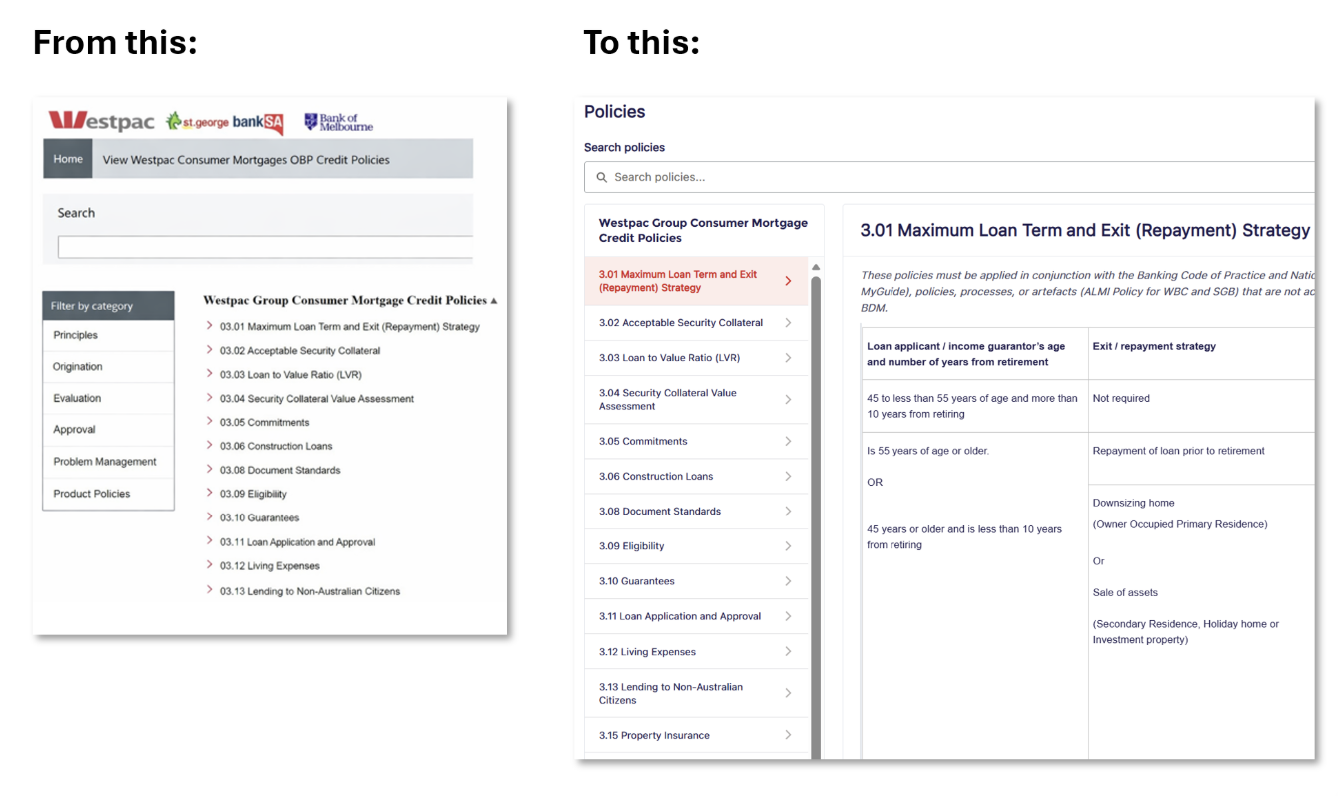
BrokerHub Credit Policy – Refreshed Interface
Easier to navigate. Easier to search. Same trusted policy content.
The Credit Policy within BrokerHub has been refreshed with a new, modern interface designed to make it easier for you to find the information you need.
What's changed?
-
Completely redesigned experience with a cleaner, more intuitive layout.
-
Enhanced search functionality to help you locate policy information quickly and efficiently.
-
Simplified navigation to make it easier to move between policy chapters and topics.
Pro Tip: Once you've selected a policy chapter, the complete policy content is displayed in the right-hand panel.
Looking for something specific? Use Ctrl+F to quickly search for keywords within the chapter and navigate directly to the information you need.
Pro Tip: Once you've selected a policy chapter, the complete policy content is displayed in the right-hand panel. Looking for something specific? Use Ctrl+F to quickly search for keywords within the chapter and navigate directly to the information you need.
CREDIT COACHING | COMPLEX PAYG INCOME
What PAYG Income Can You Really Use?
One of the most common questions brokers are asking in The Brokers' Bible is around complex PAYG income, particularly casual employment, overtime, allowances, bonuses, commissions, second jobs and even income protection.
It's important to understand how different income types are assessed, what employment or income history lenders require and what evidence we need.
Because just because a client earns $120,000 doesn't necessarily mean a lender will use the entire $120,000 for servicing.
1. Casual Income
Typically, most lenders expect borrowers to have been with their current employer for 6–12 months, while others may consider shorter employment where there's continuity in the same industry.
For example, a borrower might have only three months with their current employer but 12 months of solid, continuous employment in the same industry.
Things to know:
- Minimum time in current employment – versus employment history in the same industry.
- Income calculation and shading – whether the lender uses 100%, shades the income or annualises YTD earnings.
- Casual as the sole source of income – some lenders have additional restrictions.
- Combined working hours – some lenders have caps or assessment considerations around 50–60 hours per week.
- Essential services – these occupations can be assessed differently, with some lenders allowing as little as three months in the current role.
Documents: Current payslip with YTD earnings, previous financial-year income statement and, where necessary, an employment letter or additional payslips.
2. Overtime, Shift Loadings & Allowances
Shading rates – the big split: 80% versus 100%.
The most important thing to understand is that lenders often treat overtime differently depending on the applicant's occupation.
Standard overtime – commonly 80%
For non-essential-services occupations, many lenders shade overtime to 80%.
Essential-services overtime – potentially 100%
Many lenders recognise 100% of eligible overtime for essential-services workers, including police, firefighters, paramedics, nurses, doctors, correctional services and defence personnel.
Some policies also extend to power and energy workers, public transport, aged and disability care, and aviation.
The important thing is understanding which occupations qualify under each lender's definition of essential services.
Shift loadings and penalty rates
These are generally treated more favourably than overtime. Many lenders that shade overtime at 80% may still recognise 100% of regular shift loadings and penalty rates.
Allowances
- Fixed or ongoing allowances (car, phone, etc.): Many lenders treat contractual, recurring allowances as base income at 100%, including lenders such as Macquarie and Apollo, subject to policy.
- Variable allowances (shift, industry, location): These are often assessed similarly to overtime – potentially 80% for standard occupations or 100% for eligible essential-services workers.
Questions to ask your client:
- Do you work in an essential-services role? This can materially change the income assessment.
- Is your overtime contractual or discretionary? Some lenders recognise 100% where overtime is part of the employment agreement.
- Are shift loadings and penalty rates part of your regular roster? These may be recognised at 100%, even where overtime is shaded.
- Do you receive a fixed car or phone allowance? These may qualify as base income.
- How consistent has your overtime been over the past 6–12 months? Some lenders apply a lower-of test using recent and historical earnings.
- Are you full-time, part-time or casual? Some lenders assess casual overtime under their casual-income policy, while others separate and shade the overtime component.
3. Bonuses & Commissions
Bonuses and commissions are another area where brokers can get it wrong.
The biggest differences between lenders are the calculation method, income history required and shading applied.
- Lower of two-year average versus most recent year – the most common approach
The lender takes the lower of:
- The average bonus or commission received over the last two financial years; or
- The most recent financial year's bonus or commission.
- Average of the last two years – without a lower-of test
Some lenders simply average the previous two years without comparing the result to the most recent year.
- Most recent year or YTD income only
Some lenders use the most recent year's earnings or annualise current YTD income without a two-year comparison.
- Bonuses paid quarterly or more frequently
For more frequent bonus payments, some lenders sum the actual payments over a full 12-month period rather than annualising the most recent payment.
- Shading – 80% versus 100%
On top of the income calculation, lenders may apply a shading percentage.
- Payment frequency can change the assessment
Some lenders differentiate between annual or half-yearly bonuses and those paid quarterly or monthly.
- Annual or half-yearly: Often require two years' history, with the lower of the two-year average or most recent year used.
- Quarterly or monthly: Some lenders accept one year's history, using the payments received over 12 months or an annualised calculation.
TBB Takeaway: For many lenders, you'll need two years of bonus or commission history, with the assessable figure based on the lower of the two-year average or most recent year, commonly shaded to 80%.
4. Second Jobs & Multiple Income Sources
Most lenders assess second-job income according to the employment type of that job.
For example:
- If the second job is casual, the casual-income policy generally applies.
- If it's permanent part-time, the permanent part-time policy generally applies.
The key point is that the employment type of the second job drives its income treatment – it isn't necessarily shaded simply because it's a second job.
Tenure requirements
This is where restrictions can apply.
Many lenders require the second job to have been held for 6–12 months, although some have exceptions.
Combined working hours
Lenders also consider whether the combined working hours are sustainable.
While many lenders don't publish an exact maximum, some specify limits or assessment thresholds of approximately 50–60 hours per week.
Broker takeaway: Check the minimum tenure requirements for the second job and whether the lender has restrictions on combined working hours.
5. Parental Leave – Return-to-Work Income
Most lenders can consider return-to-work income, but there are conditions.
The key requirements are:
- Employer letter confirming the return-to-work date, employment status, hours and salary upon return.
- Evidence of how the applicant will meet commitments during leave, particularly where income is reduced or nil.
- Return to the same employer – a common requirement across many lenders.
- Childcare costs included in living expenses upon return.
- New dependant included in the application.
Return-to-work timeframe
How soon must the applicant return to work?
This can vary significantly between lenders – from approximately three months to two years, with 12 months a common policy timeframe.
Savings and income shortfall requirements
An important part of the assessment is demonstrating how the household will cover any shortfall during the leave period.
Depending on lender policy, acceptable evidence or arrangements may include:
- Savings: Bank statements showing sufficient funds to cover the shortfall.
- Home loan redraw: Available redraw on an existing loan, where permitted.
- Leave payments: Paid parental leave, annual leave or long service leave.
- Family Tax Benefit: Parts A and B may be considered as a mitigating income source under certain policies, including ING.
- Repayment deferral: Selected lenders, including NAB, may consider an approved repayment-deferral arrangement as part of the overall strategy.
Some lenders may also require a statutory declaration confirming the applicant understands their commitments and intends to use available funds to cover the shortfall.
LVR restrictions
A few lenders also impose maximum LVR restrictions where the application relies on future return-to-work income.
6. Income Protection Income
Income protection payments are generally not treated like standard PAYG income.
They're often classified as secondary or supporting income rather than primary income, and lenders impose conditions around the payments' duration and ongoing entitlement.
The key restrictions to understand:
- Medical review conditions
This is one of the biggest considerations.
Where an insurer can cease payments following a medical reassessment, this may affect whether the lender will accept the income for servicing.
- Duration of payments and retirement age
Some lenders require income protection benefits to continue for an extended period or until retirement age.
- Workers compensation is different
Income protection and workers compensation are separate types of income and may have different lender assessment requirements.
Documents to collect
An insurer letter confirming:
- Payment amount – gross and net.
- Payment frequency.
- Duration of entitlement and expiry date.
- Whether ongoing medical review or reassessment applies.
- Whether tax is deducted.
- Whether benefits continue until retirement age.
Also obtain 3–6 months of bank statements showing regular insurance payments, where required.
Final Credit Coaching Takeaway
The key message is that just because a client earns a certain amount doesn't mean every lender will recognise that full amount for servicing.
And this is particularly important when we're dealing with casual income, overtime, allowances, commissions, second jobs or other non-standard income.
Understanding how lenders calculate income, what history they require and which documents support the assessment can make a significant difference to borrowing capacity.
Sometimes it's not about the client earning more money – it's about understanding which lenders will recognise the income they're already earning.
NOT A MEMBER YET?
Join today with a 14-day free trial — month-to-month, cancel anytime.
Individual memberships start from $57 + GST per month and give you 24/7 access, on desktop and via our mobile app, plus your always-on research sidekick BrokerChat.AI.
Smarter research. Faster answers. Less stress.
What are you waiting for?

